
What Is Drawdown in Trading? How to Measure and Manage It
Drawdown is one of the most important risk metrics in trading — and one of the most misunderstood. Learn what it means, how to calculate it, and how to use it to protect your account.
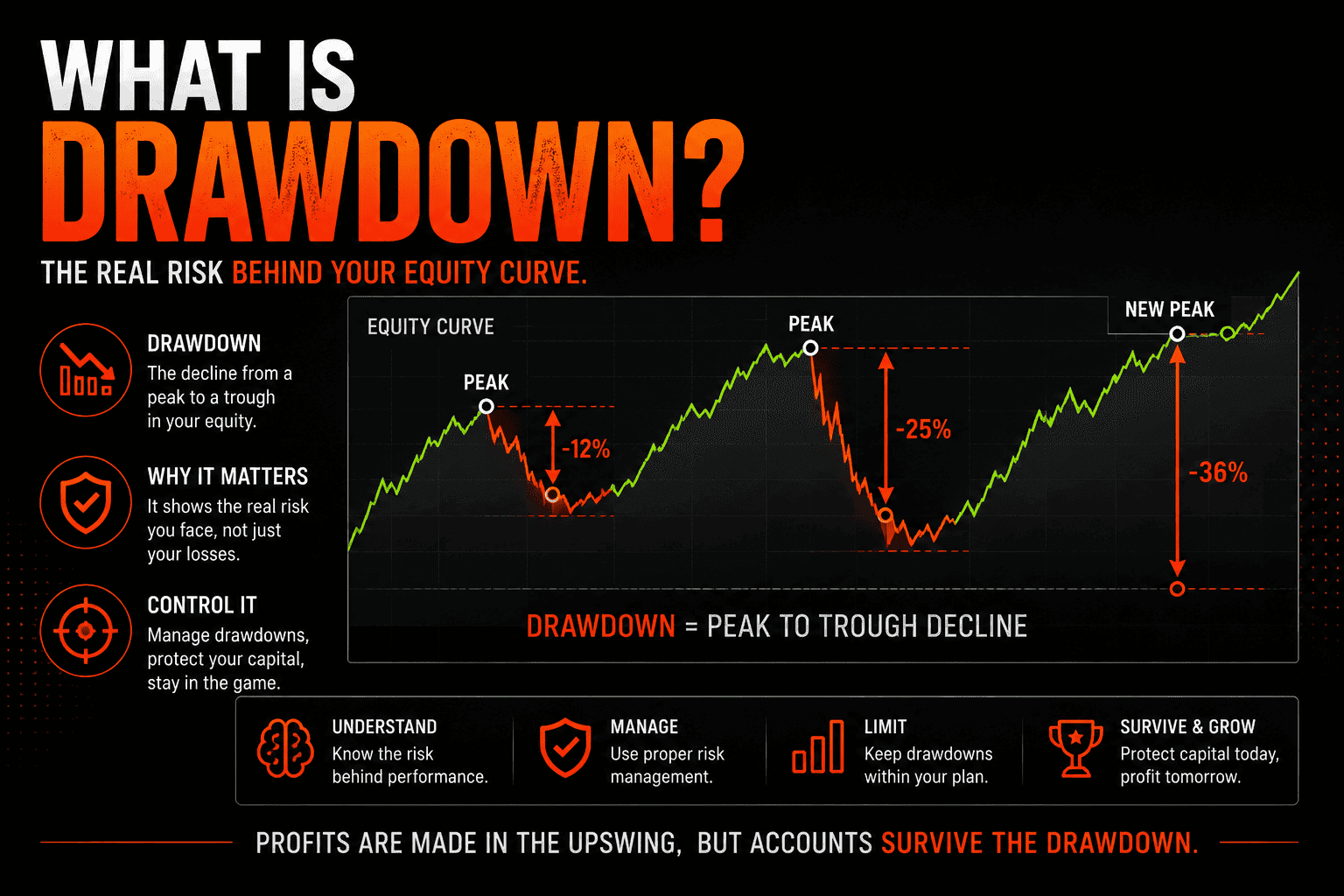
Drawdown is one of those terms that every trader hears early on but few fully understand until they experience a bad one firsthand.
It's not just about losing money. It's about how far your account falls from its peak — and what that means for your ability to recover. Understanding drawdown changes how you think about risk, position sizing, and what it actually means to have an "edge."
What Is Drawdown?
Drawdown measures the decline in your account value from its highest point to a subsequent low, before a new high is reached.
In simple terms: if your account grew to $10,000 and then fell to $8,500, you experienced a drawdown of $1,500 — or 15%.
Drawdown is always measured from a peak, not from your starting balance. If your account started at $8,000, grew to $10,000, and then fell to $8,500, your drawdown is still 15% — measured from the $10,000 peak, not the original $8,000.
This distinction matters. Drawdown tells you about the journey, not just where you started and where you are now.
Types of Drawdown
Current Drawdown
The drawdown you're in right now. If your account peaked at $12,000 and is currently at $10,800, your current drawdown is 10%. It ends when you make a new equity high.
Maximum Drawdown (Max DD)
The largest peak-to-trough decline your account has ever experienced over a given period. This is the number most risk managers and prop firms focus on.
Maximum drawdown tells you the worst case your strategy has produced historically — and gives a rough estimate of what it might produce in the future.
Relative vs. Absolute Drawdown
Relative drawdown is expressed as a percentage of the peak balance. "My max drawdown was 22%" — this is relative.
Absolute drawdown is expressed in dollar terms. "My max drawdown was $4,400" — this is absolute.
Both are useful. Relative drawdown lets you compare across different account sizes. Absolute drawdown tells you the real dollar impact on your account.
Why Drawdown Matters More Than Win Rate
Here's a concept many traders miss: a loss requires a proportionally larger gain to recover from.
The math is asymmetric:
| Drawdown | Gain Required to Recover |
|---|---|
| 10% | 11.1% |
| 20% | 25% |
| 30% | 42.9% |
| 40% | 66.7% |
| 50% | 100% |
A 50% drawdown requires a 100% gain just to get back to where you were. This is why controlling drawdown is not just about protecting capital — it's about protecting your ability to keep trading and compounding.
Two trading strategies can have the same annual return but very different drawdown profiles. The one with lower drawdown is almost always better, because the recovery path is shorter and the psychological cost is lower.
The Psychological Cost of Drawdown
Numbers on a spreadsheet don't capture what it actually feels like to be in a significant drawdown.
A 20% drawdown, even if it's within the historical range of your strategy, tests your confidence in a way that's hard to prepare for. You start questioning whether your edge still works, whether you should change your approach mid-drawdown, or whether you should stop trading entirely.
The traders who recover from drawdowns successfully are usually those who:
- Knew their strategy's historical max drawdown before trading it
- Were mentally prepared for that level of loss
- Did not make impulsive changes during the drawdown
This is why tracking your drawdown in real time — not just your P&L — is so important. If your current drawdown is within the historical range of your strategy, it's information. If it exceeds that range, it's a signal to investigate.
What Causes Drawdowns?
Drawdowns are a normal part of any trading strategy. Even the best-performing strategies in the world have drawdown periods. They happen for several reasons:
Normal statistical variance. Even a strategy with a strong edge will have losing streaks. That's just probability at work.
Market regime changes. A strategy that works well in trending markets may struggle during choppy, range-bound conditions. Drawdowns often coincide with the market doing something your strategy wasn't designed for.
Overtrading or position sizing errors. Taking too large a position on a single trade can create a drawdown that takes months to recover from, even if the underlying strategy is sound.
Emotional decision-making. Moving stops, adding to losing positions, revenge trading — these turn manageable losses into serious drawdowns.
How to Manage Drawdown
Know Your Strategy's Historical Max Drawdown
Before trading any strategy live, backtest it or review its track record. What is the historical maximum drawdown? How long did it take to recover? This sets your expectations and helps you decide if you can psychologically handle what the strategy might produce.
Size Positions to Limit Drawdown
Position sizing is the most direct tool you have for controlling drawdown. A common rule is to risk no more than 1-2% of your account on any single trade. With this approach, even a losing streak of 10 consecutive losses only draws down your account by 10-18% — painful but recoverable.
Risking 5-10% per trade can turn a normal losing streak into an account-threatening drawdown.
Set a Maximum Daily or Weekly Drawdown Limit
Many professional traders set a hard rule: if my account drops X% in a day (or week), I stop trading and review. This prevents one bad session from becoming a catastrophic drawdown.
For example: "If I lose 3% in a single day, I close all positions and don't trade again until the next session."
Reduce Size During Drawdowns
Some traders scale down their position size during drawdown periods. If your account is down 10% from its peak, you trade at 50% of your normal size. This slows the pace of any further decline and can also calm the psychological pressure.
Review, Don't Panic
When you're in a drawdown, the instinct is to change something — your strategy, your timeframe, your market. Sometimes this is the right call. More often, it's an emotional reaction that leads to more mistakes.
The better approach is to review your recent trades systematically: Are the losses within your strategy's normal parameters? Are you executing your rules correctly? Is the market in a regime your strategy struggles with? Answer those questions before making any changes.
Drawdown in Prop Trading and Funded Accounts
If you trade a funded account through a proprietary trading firm, drawdown limits are typically enforced as hard rules. Breach the maximum drawdown threshold and the account is closed.
Most prop firms use either:
- Static drawdown: A fixed dollar amount from your starting balance (e.g., you can never lose more than 10% of the initial balance)
- Trailing drawdown: A limit that follows your equity high (e.g., you can never be more than 8% below your highest equity point)
Trailing drawdown is stricter — it moves up with your profits but never moves down. Understanding which type your firm uses changes how aggressively you should trade.
Tracking Your Drawdown in Real Time
To manage drawdown, you need to see it clearly. Most traders don't track it until it's already serious.
With EdrisFinance, your drawdown is calculated automatically every time you import trades. You can see your current drawdown, your historical maximum drawdown, and how long previous drawdown periods lasted before recovering. This gives you the context you need to make calm, informed decisions rather than reactive ones.
Track your drawdown and performance for free →
Summary
Drawdown measures how far your account has fallen from its peak — and it's one of the most important risk metrics in trading. A high win rate means nothing if your drawdowns are large enough to wipe out your gains or your account.
The key principles to remember: losses require proportionally larger gains to recover from, so keeping drawdowns small protects your compounding. Know your strategy's historical max drawdown before you trade it live. Size positions to limit how deep any single losing streak can take you. And track your drawdown in real time so you're never caught off guard by how far you've fallen.
Start tracking your trades for free
Import your trades from MetaTrader, Binance, and 40+ brokers. Get instant analytics and AI-powered weekly insights.
Get started free →