
How to Read a Trading Journal: Turning Data Into Better Decisions
A trading journal is only useful if you know how to read it. Here's how to analyze your trade history, spot patterns, and use the data to actually improve your performance.
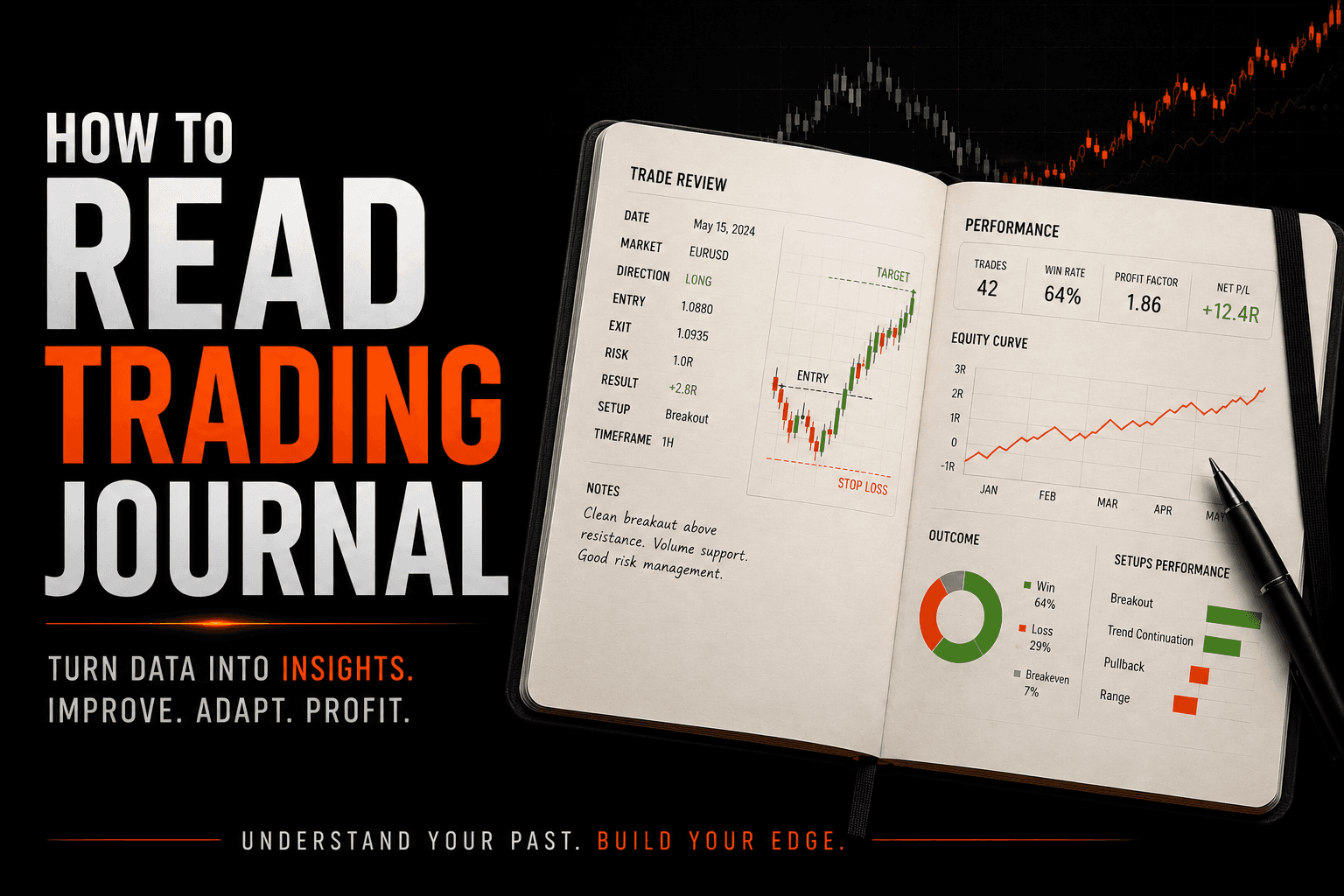
Most traders who keep a journal make the same mistake: they log trades but never go back to read them.
A trading journal is not a diary. It's a dataset. And like any dataset, its value comes not from recording it but from analyzing it. The traders who improve fastest are the ones who develop a systematic process for reviewing their journal — not just scrolling through past trades, but looking for patterns that tell them something actionable.
This guide walks you through how to actually read your trading journal and turn what you find into better decisions.
Start With the Big Picture
Before diving into individual trades, look at the overall shape of your performance. You want to understand the general trend before trying to diagnose specific problems.
Questions to answer first:
- Is your equity curve going up, down, or sideways over the period you're reviewing?
- Is your P&L improving month over month, or is it inconsistent?
- What is your current drawdown from peak equity?
This gives you context. If your equity curve is steadily rising with manageable drawdowns, your review will focus on optimizing what's already working. If it's declining or choppy, you're looking for what's going wrong.
The Six Metrics Worth Focusing On
There are dozens of metrics you can track, but most of them aren't worth obsessing over. These six tell you most of what you need to know.
1. Win Rate
The percentage of trades that closed in profit. Useful as context, but never in isolation — always read it alongside your average win and average loss.
A 60% win rate means nothing if your average loss is three times your average win.
2. Average Win vs. Average Loss
This is where most traders find their biggest insight. Calculate the average dollar amount of your winning trades and the average dollar amount of your losing trades.
If your average win is $180 and your average loss is $240, you need a win rate above 57% just to break even. Many traders are in exactly this situation without realizing it — they feel like they're trading well because they win often, but the numbers don't support it.
3. Expectancy
Expectancy combines win rate and average win/loss into a single number: the average amount you make (or lose) per trade.
Expectancy = (Win Rate × Average Win) – (Loss Rate × Average Loss)
Positive expectancy means you have an edge. Negative expectancy means you're losing money long-term regardless of how many trades you take. This is the single most important number in your journal.
4. Maximum Drawdown
The largest peak-to-trough decline in your account over the period. This tells you the worst case your trading has produced — and whether you're operating within an acceptable risk range.
5. Profit Factor
Profit factor is the ratio of your total gross profit to your total gross loss.
Profit Factor = Total Gross Profit ÷ Total Gross Loss
A profit factor above 1.0 means you're profitable. Above 1.5 is solid. Above 2.0 is excellent. Below 1.0 means you're losing money overall.
6. Average Trade Duration
How long do your winning trades last compared to your losing trades? Ideally, winners stay open longer than losers. If your losers consistently run longer than your winners, it's a sign you're holding losing trades too long or cutting winners too early.
Break Down Performance by Category
Once you understand your overall numbers, break them down by category. This is where most of the actionable insights are.
By Symbol or Asset
Are you profitable on EURUSD but losing on GBPJPY? Profitable on tech stocks but struggling with commodities? Some traders have a genuine edge in specific markets and should focus there rather than trading everything.
Look at your win rate, average win, average loss, and profit factor for each symbol you trade. You may find that 80% of your losses come from 20% of the symbols you trade.
By Time of Day or Session
Markets behave differently at different times. The London open is different from the New York afternoon. Crypto behaves differently on weekends.
Filter your trades by time and see if your performance varies significantly by session. Many traders discover they have strong results during one session and negative results during another — and that stopping trading outside their best hours dramatically improves their overall numbers.
By Trade Direction (Long vs. Short)
Are you profitable on long trades but struggling on shorts? Or vice versa? This can reveal a bias in your analysis or a mismatch between your strategy and the prevailing market trend.
By Setup or Strategy
If you trade multiple setups, log them separately and review them separately. A setup that's costing you money shouldn't be averaged out by one that's working well — it should be identified and either fixed or dropped.
Look for Behavioral Patterns
Numbers tell you what happened. But your journal notes — if you kept them — tell you why.
Are your biggest losses trades where you broke your rules? Many traders find that their average loss is reasonable, but they have a handful of outsized losses from trades where they moved their stop, added to a losing position, or held through a news event they knew was coming.
Did you cut winners early? Compare your planned take profit levels to where you actually closed trades. If you consistently exited at 60% of your target, your actual R:R is much lower than your planned R:R.
Were there emotional patterns? If you logged your emotional state — stressed, confident, frustrated, tired — look at whether certain states correlate with worse performance. Many traders find that trades taken after a big loss perform significantly worse than their average.
Did you overtrade on certain days? Look at your number of trades per day. High-frequency days often show worse results because overtrading tends to happen when you're chasing losses or feeling impatient.
The Weekly Review Process
A trading journal review doesn't need to take hours. A consistent weekly review of 20-30 minutes is more valuable than an occasional deep dive.
A simple weekly structure:
Monday (5 minutes): Look at last week's overall P&L and trade count. Was it in line with your expectations?
Midweek (10 minutes): Review individual trades from the past few days. Flag anything that deviated from your plan — both positively and negatively.
Friday (15 minutes): Run through your key metrics for the week. Note one thing that went well and one thing to improve next week.
Write a one-paragraph summary of the week. This becomes valuable context when you look back months later.
The Monthly Review Process
Once a month, zoom out and look at the bigger picture.
- Compare this month's metrics to the previous three months
- Check if your profit factor is trending up, down, or stable
- Review your best and worst trades — what made the best ones work, and what went wrong on the worst?
- Assess whether you're following your rules consistently or drifting
The monthly review is also the right time to make any significant changes to your approach. Small, incremental adjustments based on data are much more effective than dramatic strategy overhauls made in the heat of a bad week.
What Good Looks Like
After doing this for a while, you develop a clearer picture of what your personal trading edge actually looks like. It's rarely what you thought it would be when you started.
You might discover your edge is strongest on EURUSD during the London session with a 1:2 R:R, long only, on 4-hour breakouts. Everything else you trade is noise or a slight drag on performance.
That kind of clarity — knowing exactly where your edge lives — is what separates traders who improve from traders who spin their wheels for years. It comes directly from reading your journal systematically.
Making Journal Review Easier
The biggest barrier to consistent journal review is friction. If you have to manually calculate metrics from a spreadsheet every week, you'll do it once and then stop.
EdrisFinance imports your trades automatically from MetaTrader, Binance, Interactive Brokers, and 40+ other brokers, then calculates all of these metrics for you in real time. Your win rate, expectancy, profit factor, drawdown, performance by symbol and session — all visible the moment you log in.
The AI Weekly Report goes a step further: every week, it reads your recent trade data and gives you a narrative coaching summary — what your numbers suggest about your current edge, where you're leaving money on the table, and one specific thing to focus on next week.
Start your free trading journal →
Summary
A trading journal only has value if you actually read it. The key is to look beyond individual trades and find the patterns: which symbols and sessions produce your best results, whether your average win is larger than your average loss, and whether your behavioral patterns are helping or hurting you.
Start with the six core metrics — win rate, average win/loss, expectancy, drawdown, profit factor, and trade duration. Break them down by symbol, time, and setup. Review weekly and monthly. Write notes when you deviate from your plan, both when it works and when it doesn't.
Over time, this process reveals your actual edge — not the edge you think you have, but the one your data shows you have. That's the foundation for real, consistent improvement.
Start tracking your trades for free
Import your trades from MetaTrader, Binance, and 40+ brokers. Get instant analytics and AI-powered weekly insights.
Get started free →