
How to Pass an FTMO Challenge: A Realistic Guide for Serious Traders
Most traders fail the FTMO Challenge not because they can't trade — but because they don't prepare for the rules. Here's what actually matters.
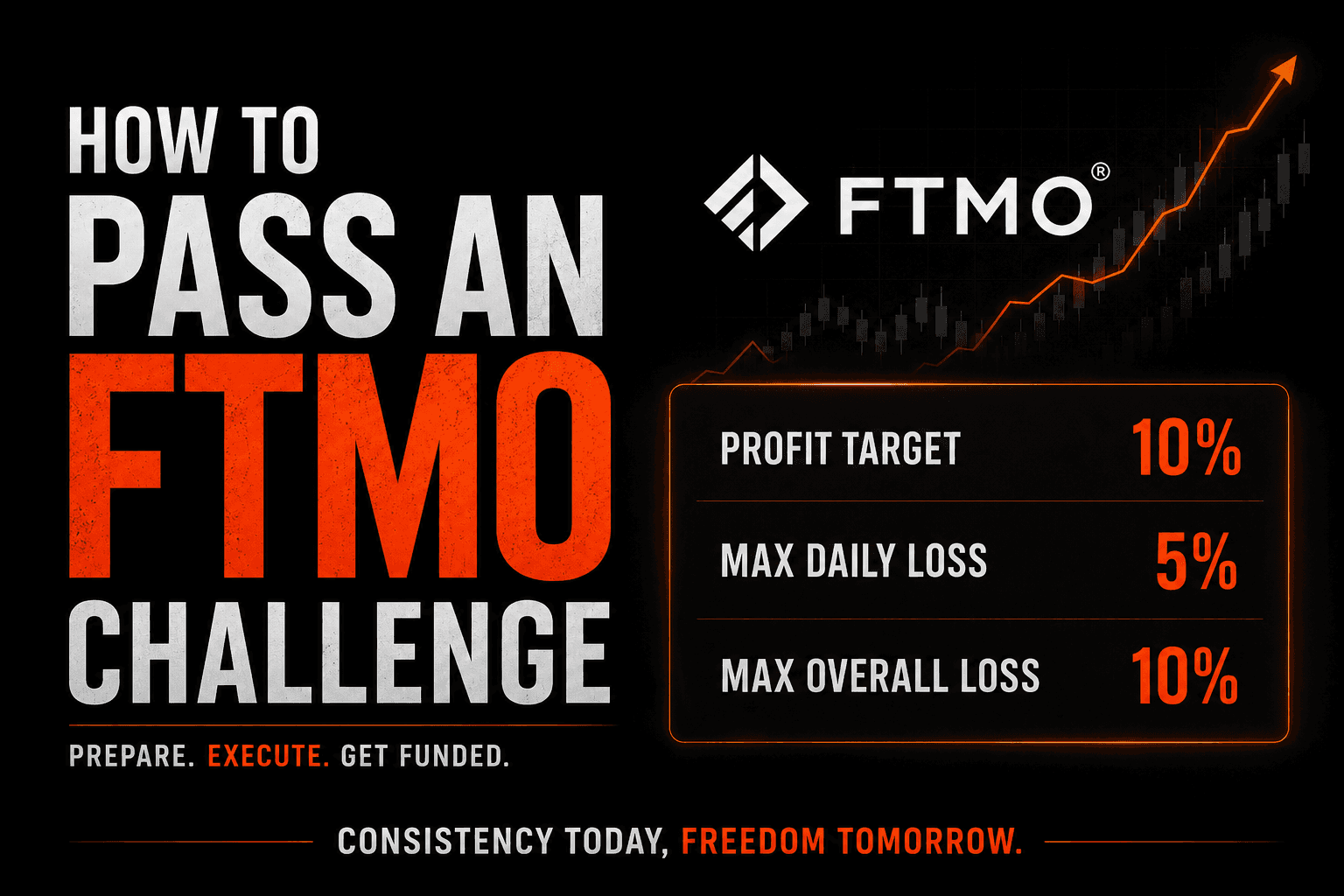
The FTMO Challenge has become the standard benchmark for prop trading. Pass it and you get access to a funded account — up to $200,000 — with FTMO taking on all the risk. Fail it and you're out your evaluation fee and a few weeks of trading.
Most traders who fail don't fail because they can't trade. They fail because they underestimate the ruleset, overtrade when they're close to the target, or blow up in the final days trying to push for a result. This guide covers what actually matters — not the generic advice you'll find everywhere else.
What the FTMO Challenge Actually Requires
Before anything else, you need to understand exactly what you're signing up for. The FTMO Challenge has two phases:
Phase 1 (Challenge):
- Profit target: 10% of account size
- Maximum daily loss: 5%
- Maximum overall loss: 10%
- Minimum trading days: 4
- No time limit (as of recent rule updates)
Phase 2 (Verification):
- Profit target: 5%
- Same loss limits as Phase 1
- Minimum trading days: 4
Once you pass both phases, you become an FTMO Trader with a funded account. Profit split starts at 80/20 in your favor and can reach 90/10.
The rules look simple on paper. The challenge is staying within them while also making money.
The Loss Limits Are Where Most Traders Fail
The 5% daily loss limit and 10% maximum overall loss are not soft guidelines — they're hard stops. One bad day can end your challenge before you've had a chance to recover.
A few things that catch traders off guard:
The daily loss is calculated from the previous day's closing balance, not from your starting balance. If you made 3% yesterday, your daily loss limit today is 5% of your new, higher balance. This works in your favor — but it also means a bad day after a good run can still wipe you out if you're not paying attention.
Floating losses count. If you have open positions that are down 4.9%, you're almost at your daily limit even if no trades have been closed. This is one of the most common ways traders accidentally breach — they don't account for unrealized drawdown.
A single news event can do it. Trading around major macro events (NFP, CPI, central bank decisions) with a full-size position is how challenges end in minutes. If you're not confident in your news trading, don't do it during an evaluation.
How to Set a Realistic Daily Target
Here's a simple way to think about target-setting. On a $100,000 FTMO Challenge, your profit target is $10,000. With no time limit, you have room to be patient.
If you aim for 0.5% per day on average, you hit your target in 20 trading days — about four calendar weeks. That's a pace that gives you room to have losing days without panicking.
Traders who try to hit 2–3% per day are putting unnecessary pressure on themselves. Even if they have the skill, the emotional weight of each session changes how they trade. They hold losers too long trying to avoid a red day. They revenge trade after a loss. They overtrade when they're close to the target.
Slow, consistent progress passes more challenges than big, aggressive pushes.
Choosing the Right Strategy for an Evaluation
Not every strategy that makes money in a personal account is suitable for an FTMO Challenge. The ruleset filters out certain approaches by design.
Strategies that tend to work well:
- Intraday trend-following on major forex pairs or indices
- Scalping during London or New York session overlap (high liquidity, tighter spreads)
- Swing trades with defined risk and reasonable R:R
Strategies that tend to cause problems:
- Martingale or averaging down — one bad sequence and you're done
- High-frequency scalping with very small targets (spread eats too much)
- News trading without a clear, tested edge
- Grid trading — FTMO prohibits certain forms of it explicitly
Read the FTMO trading objectives page before you start. Some strategies are restricted or prohibited outright, and they do check.
Position Sizing: The Most Practical Part
This is where preparation actually shows up. Before you start the challenge, define your position sizing rules and don't change them mid-challenge.
A simple framework for a $100,000 account:
- Risk per trade: 0.5–1% ($500–$1,000)
- Maximum concurrent risk: 2–3% ($2,000–$3,000)
- Daily stop: If you lose 2.5–3%, stop trading for the day
These numbers give you room to have bad days without hitting the 5% daily limit. They also mean a losing streak of 5–10 trades in a row still won't end your challenge — which matters because losing streaks happen to every trader.
If you're not used to trading with defined position sizing rules, practice this on a demo account first. Following your rules when you're down $800 on a trade takes more discipline than most traders expect.
Managing the Psychology of the Evaluation
Most traders have a different emotional experience during an FTMO Challenge than during their regular trading. The stakes feel higher. The rules create artificial pressure. You become more aware of each trade.
A few patterns that tend to derail challenges:
Overtrading near the target. When you're at 8% profit and need 2% more, the temptation to "get it done" in a session is strong. This is usually when traders take lower-quality setups, increase position size, or hold past their normal exit points. The challenge doesn't have a deadline — there's no reason to rush.
Checking the balance too often. Looking at your P&L every few minutes keeps you emotionally engaged in a way that affects your decisions. Check it at the end of each session, not during.
Treating a losing day as a failure. A losing day within your daily stop rules is part of the process, not a sign that you're going to fail. What matters is that you stopped at your pre-defined limit and came back the next day.
Tracking Your Progress During the Challenge
One of the less-discussed aspects of passing an FTMO Challenge is having clear visibility into your numbers at all times — not just your profit target, but your daily loss, your overall drawdown, your win rate, and your average R:R per trade.
When you know exactly where you stand, you make better decisions. You don't need to calculate mentally whether you can take one more trade today. You know.
With EdrisFinance, you can import your FTMO trades directly and see your challenge progress in real time — including your current drawdown, profit target progress, and daily stats. The Funding module tracks the FTMO rules automatically so you always know where you stand.
Start tracking your FTMO challenge for free →
The Week Before You Pass
The final stretch of a challenge is where discipline is most important and usually where it breaks down. You're close to the target, you've been trading well, and the temptation to lock in the result is real.
A few things worth doing in the final week:
- Reduce position size slightly if you're within 1–2% of your target. You don't need to take the same risk to close the remaining gap.
- Don't add new strategies or timeframes. Stick to what got you here.
- If you've already met the minimum trading days requirement and your target is close, a quiet session with small positions is a completely valid approach.
There's no prize for passing with extra room to spare, but there's a real cost to failing in the final days. Protect what you've built.
Summary
Passing the FTMO Challenge comes down to three things: knowing the rules cold, having a position sizing plan you actually follow, and managing the pressure that comes with trading under evaluation conditions.
The profit target is achievable for most traders with a real edge. What eliminates most candidates is one bad day that hits the daily loss limit, or a final-week mistake when the finish line was already in sight.
Trade your normal strategy, size down slightly if anything, don't rush the target, and track your numbers carefully. That's the actual advice — without any of the hype.
Start tracking your trades for free
Import your trades from MetaTrader, Binance, and 40+ brokers. Get instant analytics and AI-powered weekly insights.
Get started free →