
How to Calculate Position Size in Trading
Position sizing is one of the most important skills in trading. Learn how to calculate the right lot size for any trade so you never risk more than you intend.
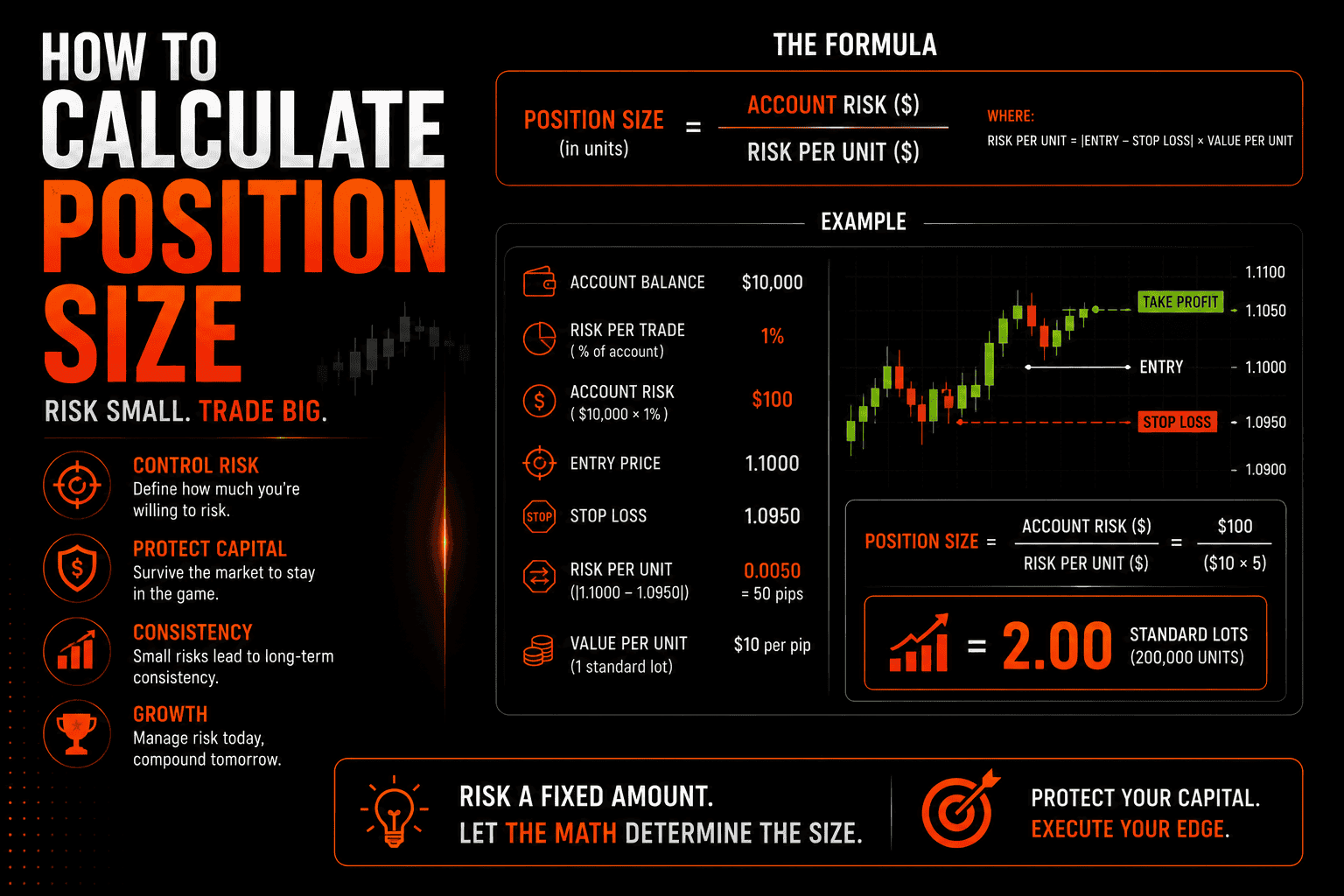
One of the most common mistakes new traders make is deciding how much to trade based on gut feeling. They pick a round number — "I'll buy 1 lot" or "I'll buy 100 shares" — without connecting that number to how much they're actually willing to lose.
Position sizing fixes this. It's the process of calculating exactly how many units, shares, or lots to trade so that if the trade hits your stop loss, you lose a specific, predetermined amount — no more.
It sounds simple, and the math actually is. But getting it right consistently changes the entire character of your trading.
The Core Idea
Every trade has two inputs you define before entering:
- How much you're willing to lose (your risk in dollars)
- Where your stop loss is (your risk in price terms)
From those two inputs, you can calculate exactly how large your position should be.
The formula:
Position Size = Risk Amount ÷ (Entry Price – Stop Loss Price)
This gives you the number of units (shares, currency units, etc.) to trade. From there, you convert to lots if you're trading forex.
Step 1: Define Your Risk Per Trade
The first question is: how much of your account are you willing to lose on this trade?
The most common rule among professional traders is 1-2% of account balance per trade.
If your account is $10,000:
- 1% risk = $100 per trade
- 2% risk = $200 per trade
This means even if you hit 10 consecutive losing trades, your account is down 10-18% — painful but recoverable. Risking 5-10% per trade turns a normal losing streak into a serious drawdown.
The percentage you choose depends on your risk tolerance and your strategy's win rate. Lower win rate strategies generally require tighter risk per trade to survive losing streaks.
Step 2: Determine Your Stop Loss Distance
Your stop loss should be placed at a level that invalidates your trade idea — not at a random distance or at a round number.
For example:
- You want to go long on a stock at $50
- Your stop loss is at $47.50 (below a key support level)
- Stop distance = $50 – $47.50 = $2.50 per share
Step 3: Calculate Position Size
Now you have both inputs. Let's put the formula to work.
Example: Stock trading
- Account size: $10,000
- Risk per trade: 1% = $100
- Entry price: $50
- Stop loss: $47.50
- Stop distance: $2.50
Position Size = $100 ÷ $2.50 = 40 shares
If the trade hits your stop at $47.50, you lose 40 shares × $2.50 = $100. Exactly 1% of your account. No guesswork.
Position Sizing for Forex: Calculating Lot Size
Forex adds one layer of complexity because currencies are traded in lots, and the pip value depends on the currency pair and your account currency.
Key terms:
- Standard lot = 100,000 units of base currency
- Mini lot = 10,000 units
- Micro lot = 1,000 units
- Pip = the smallest standard price move (0.0001 for most pairs)
For most USD-quoted pairs (EURUSD, GBPUSD):
- 1 standard lot = $10 per pip
- 1 mini lot = $1 per pip
- 1 micro lot = $0.10 per pip
Forex position sizing formula:
Lot Size = Risk Amount ÷ (Stop Loss in Pips × Pip Value)
Example: EURUSD trade
- Account size: $10,000
- Risk per trade: 1% = $100
- Entry: 1.0850
- Stop loss: 1.0800
- Stop distance: 50 pips
- Pip value (standard lot): $10
Lot Size = $100 ÷ (50 × $10) = $100 ÷ $500 = 0.2 lots
So you trade 0.2 standard lots (or 2 mini lots). If price hits your stop, you lose 50 pips × $10 × 0.2 = $100. Exactly what you planned.
The Impact of Stop Loss Distance on Position Size
Notice what happens when your stop loss distance changes.
Using the same $100 risk:
| Stop Distance (pips) | Lot Size |
|---|---|
| 20 pips | 0.50 lots |
| 50 pips | 0.20 lots |
| 100 pips | 0.10 lots |
| 200 pips | 0.05 lots |
A tighter stop allows a larger position. A wider stop requires a smaller position. This is why moving your stop further away to "give the trade more room" isn't free — it means you must trade smaller to keep your risk the same.
Many traders do the opposite: they keep their lot size fixed and widen their stop, which silently increases the amount they're risking without realizing it.
Common Position Sizing Mistakes
Using a fixed lot size regardless of stop distance. If you always trade 0.1 lots no matter where your stop is, your actual risk in dollars varies wildly with every trade. Some trades you're risking $50, others $300. Your results will be inconsistent even if your strategy is sound.
Placing stops to fit a desired lot size. Some traders decide they want to trade 1 lot, then calculate where their stop needs to go to keep risk "acceptable." This gets the process backwards — your stop should be placed at a technically valid level, not engineered around your preferred position size.
Ignoring account currency. If your account is in euros and you're trading USDJPY, pip values need to be converted to euros. Most brokers handle this automatically, but it's worth understanding.
Not adjusting after a drawdown. As your account balance changes, your risk amount should change too. After a 15% drawdown, 1% of your account is less than it was before. Recalculate your risk amount regularly.
A Simple Rule to Remember
Before entering any trade, ask yourself:
"If this trade hits my stop, how much do I lose in dollars?"
If you can't answer that immediately, your position sizing process needs work. If the answer is more than 1-2% of your account, your position is too large.
This one question, asked consistently before every trade, will do more for your long-term results than almost any other change you can make.
Tracking Position Size Discipline Over Time
One of the most revealing things you can analyze in your trading journal is whether you're actually following your position sizing rules — or whether your real risk per trade is drifting above your intended level.
With EdrisFinance, every trade you import includes the position size, entry, and stop data. You can see your average risk per trade, identify trades where you sized up beyond your rules, and measure how consistently you're applying your risk management.
Over time, this data shows whether your position sizing discipline is improving — and whether the outlier losses that hurt your equity curve are coming from strategy failure or from taking oversized positions.
Track your trades and risk management for free →
Summary
Position sizing is the bridge between your strategy and your risk management. The formula is simple: divide the dollar amount you're willing to risk by the distance to your stop loss. The result tells you exactly how many units or lots to trade.
The key habits to build: always define your stop loss before calculating position size, always work backward from a percentage of your account rather than picking a round lot number, and recalculate every time your account balance changes significantly.
A trader with an average strategy and excellent position sizing will outperform a trader with a great strategy and poor position sizing — every time, over the long run.
Start tracking your trades for free
Import your trades from MetaTrader, Binance, and 40+ brokers. Get instant analytics and AI-powered weekly insights.
Get started free →