
Head and Shoulders Pattern: How to Identify and Trade It
Learn how to identify the head and shoulders chart pattern, understand what it signals, and how experienced traders use it to time entries and exits.
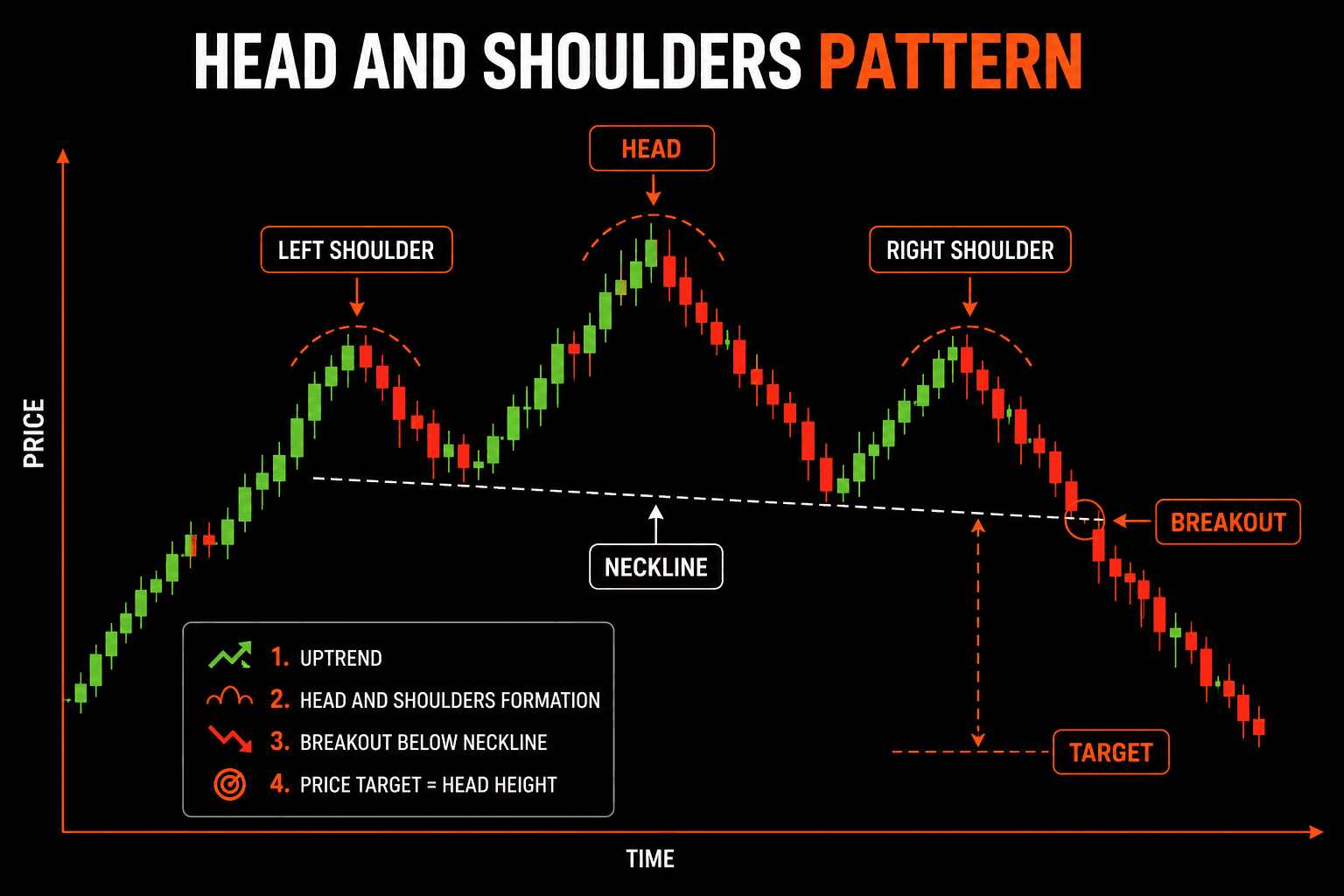
The head and shoulders pattern is one of the most reliable reversal patterns in technical analysis. It appears across all timeframes and all markets — stocks, forex, crypto, commodities — and has been studied by traders for over a century.
This guide covers everything you need to know: how to identify it correctly, what it actually means, how to trade it, and the mistakes most traders make when they see one.
What Is the Head and Shoulders Pattern?
The head and shoulders pattern is a bearish reversal formation that signals the end of an uptrend. It consists of three peaks:
- Left shoulder — a peak followed by a pullback
- Head — a higher peak, followed by another pullback to roughly the same level as the first
- Right shoulder — a third peak, lower than the head, roughly equal in height to the left shoulder
The line connecting the two pullback lows is called the neckline. When price breaks below the neckline after forming the right shoulder, the pattern is considered complete and signals a potential trend reversal.
Why Does This Pattern Form?
Understanding the psychology behind the pattern makes it more reliable — you're not just following lines on a chart, you're reading market behavior.
Left shoulder: The market is in an uptrend. Buyers push price to a new high, but some sellers take profit at the top. Price pulls back, but bulls step in again.
Head: Buyers try one more push, reaching an even higher high. This looks like the uptrend is intact. But again, sellers appear at the top. The pullback brings price back to around the same level as the first pullback — the neckline area.
Right shoulder: Bulls make one final attempt. But this time they can't push as high as before. The momentum is fading. When sellers push price back down and break the neckline, it confirms that buyers have exhausted themselves and sellers are taking control.
This is the moment the pattern triggers.
How to Identify a Valid Head and Shoulders Pattern
Not every three-peak formation is a head and shoulders. Here's what separates a valid pattern from a false one:
The head must be clearly higher than both shoulders. If the three peaks are roughly equal, you're looking at a triple top, not a head and shoulders.
The two shoulders should be roughly symmetrical. They don't need to be identical — a few percent difference is fine — but a dramatically lopsided pattern is less reliable.
The neckline should be roughly horizontal or slightly sloped. A sharply sloped neckline makes the pattern less reliable.
Volume should decrease from left shoulder to head to right shoulder. This confirms that buying momentum is fading. Volume typically picks up on the neckline breakdown.
The pattern takes time to form. A head and shoulders that develops over a few hours on a 1-minute chart is less significant than one that takes weeks to form on a daily chart.
The Neckline: Where the Pattern Triggers
The neckline is the most important level to watch. It connects the low after the left shoulder with the low after the head.
The pattern is not confirmed until price closes below the neckline. Many traders make the mistake of entering short as soon as the right shoulder forms — this is premature. The neckline break is the signal.
How to draw the neckline:
- Find the lowest point of the pullback after the left shoulder — mark it
- Find the lowest point of the pullback after the head — mark it
- Connect those two points and extend the line to the right
Some necklines are slightly sloped — sloping down is more bearish (sellers were already active), sloping up means buyers held up well before the eventual break.
How to Trade the Head and Shoulders Pattern
There are two main approaches traders use:
Approach 1: Trade the Neckline Break
Entry: Short when price closes below the neckline (conservative traders wait for the candle to close, not just touch)
Stop loss: Above the right shoulder high
Target: Measure the distance from the head to the neckline, then project that same distance downward from the neckline break point
For example: if the head is at $150 and the neckline is at $130, the pattern target is $130 - $20 = $110.
Approach 2: Trade the Retest
After the neckline breaks, price often pulls back to retest the neckline from below (what was support becomes resistance). This gives a second, lower-risk entry with a tighter stop.
Entry: Short on the retest of the neckline from below, with price showing rejection
Stop loss: Above the neckline (which is now resistance)
Target: Same measured move as above
The retest doesn't always happen — sometimes price just continues down without looking back. This is why many traders split their position: enter half on the break, add the other half if the retest occurs.
The Inverse Head and Shoulders
The inverse (or reverse) head and shoulders is the bullish equivalent. It appears at the end of a downtrend and signals a potential reversal upward.
Instead of three peaks, you get three troughs:
- Left shoulder: a low followed by a bounce
- Head: a lower low, followed by another bounce
- Right shoulder: a higher low (roughly equal to left shoulder), followed by a break above the neckline
Everything works the same way — just mirrored. The neckline break is to the upside, the measured target is calculated upward, and volume should increase on the breakout.
The inverse head and shoulders is generally considered more reliable than the standard version, because markets tend to move upward more gradually than they fall.
Common Mistakes Traders Make
Entering before the neckline breaks. The right shoulder looks like a shorting opportunity, but price can still make one more run to new highs. Wait for the neckline break.
Using the pattern on very short timeframes. A head and shoulders on a 1-minute chart has minimal predictive value. The pattern is most reliable on the 4-hour, daily, and weekly timeframes.
Ignoring volume. Low volume on the right shoulder and high volume on the neckline break is the ideal setup. If volume surges on the right shoulder, buyers may still have strength.
Setting targets too aggressively. The measured move is a target, not a guarantee. Many patterns only partially complete their target before reversing. Consider taking partial profits along the way.
Not accounting for the broader trend. A head and shoulders pattern on the daily chart is much more significant when the weekly chart also shows weakness. Always check the higher timeframe context.
Head and Shoulders in Different Markets
Forex: The pattern works well on major pairs, especially on the 4-hour and daily charts. EURUSD and GBPUSD have historically shown textbook head and shoulders formations at major trend reversals.
Stocks: Some of the most famous stock reversals in history showed clear head and shoulders patterns before the decline. The pattern is particularly useful around earnings-driven tops.
Crypto: Bitcoin has formed multiple head and shoulders patterns at cycle tops. The volatile nature of crypto means more false breakouts, so waiting for confirmed neckline closes (not just wicks) is especially important.
Tracking Your Pattern Trades
Every trade based on a chart pattern should be logged and reviewed. Did the neckline hold as resistance on the retest? Did you hit your measured target? How long did the pattern take to play out?
Over time, reviewing your pattern trades in a trading journal reveals which timeframes and markets give you the most reliable setups.
With EdrisFinance, you can log every trade alongside notes on your setup rationale — including which pattern you were trading, your entry reason, and your emotional state at the time. The performance reports then let you filter by setup type to see which patterns are actually working in your trading.
Start tracking your trades for free →
Summary
The head and shoulders pattern is one of the most studied formations in technical analysis — not because it's complicated, but because it works. It captures a very real shift in market psychology: from buyer dominance to seller control.
The key points to remember are: wait for the neckline break before entering, use the measured move for your target, and always check volume to confirm the pattern. Combine it with higher timeframe context and you have one of the cleaner reversal setups available to any trader.
Start tracking your trades for free
Import your trades from MetaTrader, Binance, and 40+ brokers. Get instant analytics and AI-powered weekly insights.
Get started free →